
OPC Registration Online
Simplifying Business Needs!
OPC Registration Packages
Documents Required

Director & Nominee PAN, Aadhaar

Office Address Proof

02 Proposed Names

Business Activities

Email & Phone No.


OPC registration in India: the complete guide
Reviewed by CS Abhishek Tanwar, Filing24 · Last updated: 16 November 2026
Quick answer: OPC registration lets a single founder start a company with limited liability. You need one director (who is also the only shareholder), one nominee, PAN and Aadhaar of both, and an office address proof. With Filing24, OPC registration costs ₹6,999 for most states and takes 7–10 working days, fully online.
What is a One Person Company?
A One Person Company (OPC) is a private company owned by just one person, defined in Section 2(62) of the Companies Act, 2013. It was introduced so that solo founders, freelancers and small business owners could enjoy the protection of a company without finding a second shareholder.
Think of it as the middle path between a sole proprietorship and a Private Limited Company. You keep full control, but the business becomes a separate legal person. If the business takes a loan or faces a claim, your house, savings and personal assets stay protected.
Key features of an OPC
- Single owner: only one natural person who is an Indian citizen (resident or NRI) can be the member.
- Nominee: a nominee is named at the time of OPC registration and steps in if the owner dies or becomes incapable.
- Limited liability: your risk is limited to the capital you invest.
- Perpetual succession: the company continues even if the owner changes.
- Lighter compliance: no AGM, simpler annual return (MGT-7A) and 180 days to file accounts.
Who should choose OPC registration?
OPC registration is a smart choice if any of these sound like you:
- You are a freelancer, consultant or agency owner billing companies that prefer to work with a registered company.
- You run a small trading, D2C or e-commerce business alone and want to protect your personal assets.
- You are a proprietor whose business is growing and you want a more professional structure.
- You want a company today, with the option to add partners or investors later.
If you already have a co-founder or plan to raise funding in the next few months, a Private Limited Company is usually the better fit. Not sure? Read our OPC vs Private Limited guide.
OPC registration process: step by step
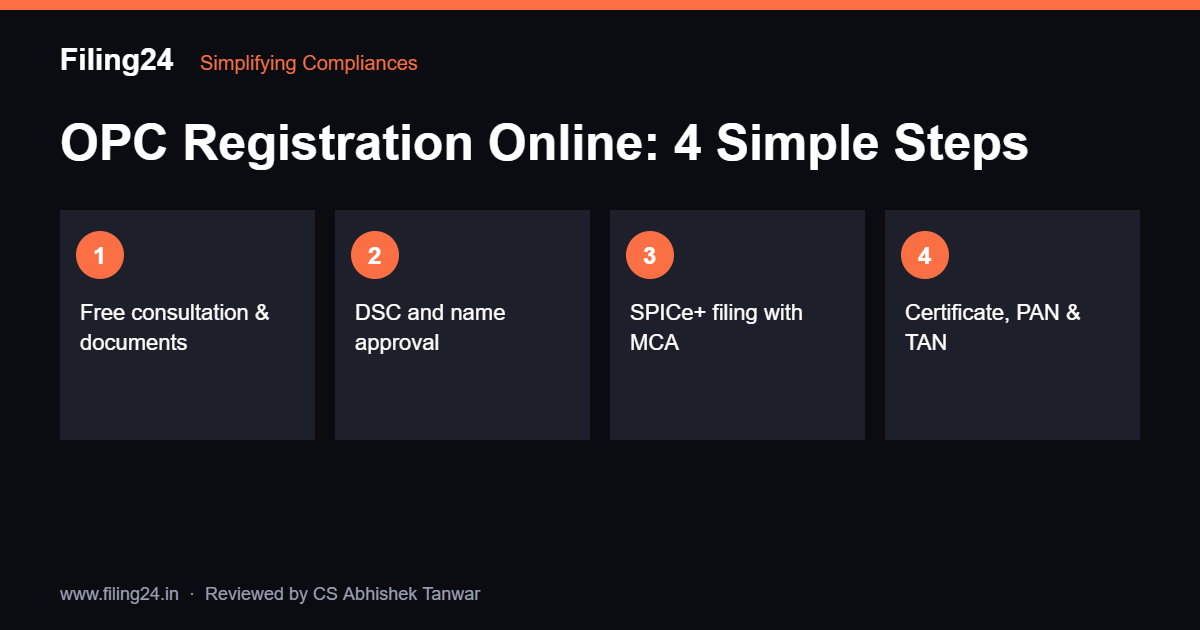
- Free consultation (Day 1): our expert understands your business, suggests names and confirms the documents.
- Digital Signature Certificate (Day 1–2): we issue a Class 3 DSC for the director using Aadhaar-based video KYC.
- Name approval (Day 2–4): we file SPICe+ Part A with two proposed names on the MCA portal.
- Incorporation filing (Day 4–6): SPICe+ Part B is filed with the e-MoA (INC-33), e-AoA (INC-34), AGILE-PRO-S (INC-35) and the nominee consent in Form INC-3.
- Certificate of Incorporation (Day 7–10): the MCA issues the certificate along with the company PAN, TAN and DIN.
You do not need to visit any office. Every document is signed digitally, and you can track progress on WhatsApp with your dedicated expert.
OPC registration fees and government charges
| Cost item | Amount |
|---|---|
| Filing24 professional fee | ₹6,999 (includes DSC, name approval and filing) |
| MCA filing fee | Nil for authorised capital up to ₹15 lakh |
| Stamp duty on MoA and AoA | As per your state, calculated on SPICe+ |
| Minimum capital | No minimum, start with any amount |
Want an exact quote for your state? Try our company registration fee calculator or simply fill the form on this page.
OPC vs sole proprietorship: why upgrade?
Most solo founders start as a sole proprietor because it needs almost no paperwork. As the business grows, the gaps start to hurt. Here is how an OPC compares.
| Point | Sole proprietorship | One Person Company |
|---|---|---|
| Liability | Unlimited, personal assets at risk | Limited to capital invested |
| Legal identity | Same as the owner | Separate legal entity |
| Credibility with clients and banks | Low to moderate | High, registered with MCA |
| Business continuity | Ends with the owner | Continues through the nominee |
| Tax | Slab rates up to 30% plus surcharge | Company tax rates, including the 22% concessional regime |
| Raising funds | Only personal loans | Business loans; convert to Pvt Ltd for equity |
If your profits are rising, an OPC can also help with tax planning, because a company can choose the concessional 22% rate (plus surcharge and cess) under Section 115BAA, and you can pay yourself a salary that is deductible for the company.
Rules and restrictions you should know
An OPC is flexible, but the law places a few limits so that it is used by genuine small businesses:
- One OPC per person: an individual can be a member of only one OPC and a nominee in only one OPC.
- No minors: a minor cannot be a member or nominee.
- Restricted activities: an OPC cannot carry on Non-Banking Financial Investment activities, including investment in securities of other companies.
- No Section 8: an OPC cannot be registered as a charitable (Section 8) company.
- Name suffix: the name must end with “(OPC) Private Limited”.
Our expert checks these points during the free consultation so that your OPC registration is not rejected later.
OPC registration for NRIs and foreign residents
Since the 2021 amendment, Non-Resident Indians who are Indian citizens can register an OPC in India. This is useful for NRIs who want to run a consulting, IT services or export business in India while living abroad.
- Residency rule: the earlier requirement of staying 182 days in India was removed for OPC members. The general rule that every company needs at least one director who stayed in India for 120 days or more in the financial year still applies, so many NRIs appoint a resident relative as an additional director.
- Documents: an NRI member needs a passport, overseas address proof and Indian PAN. Documents issued abroad must be notarised and apostilled or consularised.
- Bank account: the company opens a regular current account in India. Capital can be brought in from the NRI’s NRE or NRO account.
Foreign nationals who are not Indian citizens cannot form an OPC, but they can invest in a Private Limited Company under the FDI rules.
After OPC registration: your first 90 days
Getting the certificate is the start. Here is what a newly registered OPC should do next:
- Open a current account in the company name and deposit the share capital.
- Appoint the first auditor within 30 days through a board resolution.
- File INC-20A (commencement of business) within 180 days with proof of capital.
- Register for GST if your turnover will cross the limit, you sell inter-state goods or sell through marketplaces.
- Get Udyam (MSME) registration to access priority lending and protection against late payments.
- Set up bookkeeping from day one so that your first audit and income tax return are smooth.
Our post-incorporation compliance service covers all of these at a fixed price.
Common mistakes that delay OPC registration
- Weak name choice: names too close to an existing company or trademark get rejected. Use our free company name checker first.
- Old address proof: utility bills must be recent, ideally within the last two months.
- Mismatched details: name, date of birth and father’s name must match across PAN and Aadhaar.
- Nominee not ready: keep the nominee’s PAN, Aadhaar and consent ready in advance.
- Unclear business objects: describe your main business clearly so that the right NIC code is chosen.
These small issues are the most common reasons for resubmission. With Filing24, every document is checked by an expert before filing.
How an OPC is taxed
A One Person Company is taxed like any other domestic company. It files ITR-6 every year by 31 October, because its accounts must be audited. The company can choose the concessional tax regime of 22% (plus 10% surcharge and 4% cess) under Section 115BAA, or the normal regime. The owner pays tax separately on the salary or dividend received from the OPC.
GST, TDS and other indirect taxes apply to an OPC in the same way as any other business. Our team can handle your annual compliance, ITR and GST returns together so that nothing is missed.
Documents required for OPC registration
- PAN card of the director and the nominee
- Aadhaar card, voter ID, passport or driving licence
- Bank statement or utility bill of the director (not older than two months)
- Passport-size photograph
- Registered office proof: electricity or water bill plus rent agreement (if rented)
- No Objection Certificate from the property owner (download the NOC format)
See the full documents checklist. You can verify the OPC rules on the official Ministry of Corporate Affairs website.
Why founders choose Filing24 for OPC registration
- One fixed price: no hidden charges. Government fees are shown before you pay.
- Dedicated expert: one person handles your file from start to finish.
- Fast turnaround: most OPCs are incorporated within 7–10 working days.
- After-registration support: bank account, GST, Udyam and OPC annual compliance under one roof.
- Clear communication: updates on WhatsApp and email at every step.
Start your One Person Company today
Share your details and our expert will call you back. Free consultation, no obligation.