
OPC vs Private Limited Company
OPC vs private limited company: the complete comparison
Reviewed by CS Abhishek Tanwar, Filing24 · Last updated: 16 November 2026
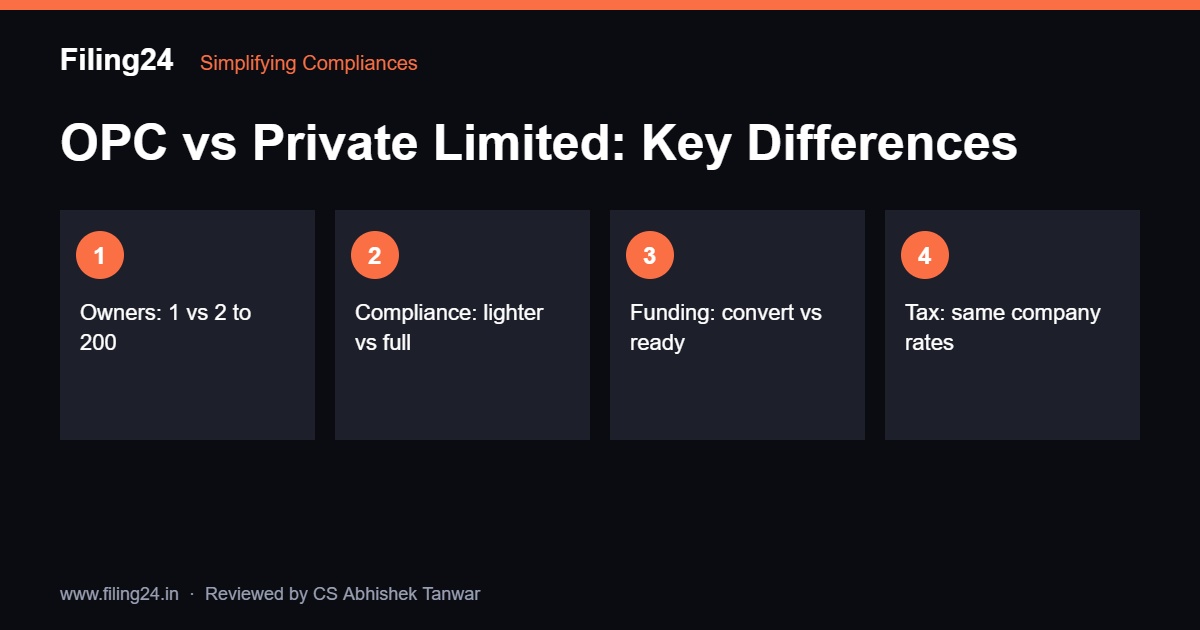
Quick answer: In the OPC vs private limited comparison, both are companies with limited liability and the same tax rates. An OPC has only one owner and lighter compliance (no AGM, MGT-7A, 180 days for accounts), but cannot raise equity or issue ESOPs without converting. A Private Limited Company needs at least two shareholders and two directors, has more compliance, but is ready for co-founders, investors and ESOPs from day one.
OPC vs private limited: 10 key differences
| Point | One Person Company | Private Limited Company |
|---|---|---|
| 1. Members | Exactly one (natural person, Indian citizen) | 2 to 200 |
| 2. Directors | Minimum 1, maximum 15 | Minimum 2, maximum 15 |
| 3. Nominee | Mandatory (INC-3) | Not required |
| 4. AGM | Not required | Mandatory every year |
| 5. Board meetings | None with one director; otherwise 1 in each half-year | 4 a year (2 for small companies) |
| 6. Annual return | MGT-7A | MGT-7 or MGT-7A (small companies) |
| 7. AOC-4 due date | 180 days from year end | 30 days from AGM |
| 8. Equity funding and ESOPs | Not possible without conversion | Possible |
| 9. Restricted activities | Cannot do non-banking financial investment activities | No such restriction |
| 10. Registration fee (Filing24) | ₹9,143 + stamp duty | ₹11,143 + stamp duty |
Both structures are taxed at the same rates and need a statutory audit every year. The real difference in the OPC vs private limited choice is ownership flexibility versus compliance load.
What is a One Person Company?
A One Person Company is a private company with a single member, introduced by the Companies Act, 2013 so that solo entrepreneurs could get limited liability without a partner. The member must be an Indian citizen (resident or NRI), and a nominee is named to take over if the member dies or becomes incapable. An OPC can have up to 15 directors, but only one shareholder.
OPCs suit freelancers, consultants, small traders and professionals who want to separate business risk from personal assets. Learn more about OPC registration.
What is a Private Limited Company?
A Private Limited Company has between 2 and 200 shareholders and at least two directors, one of whom must be resident in India. Shares cannot be offered to the public, and transfers are restricted by the Articles of Association. It is the structure used by most Indian startups and growing businesses because it allows co-founders, investors and employees to own shares.
OPC vs private limited: compliance compared
Compliance is where the two structures differ the most in daily life.
- Meetings: an OPC with one director needs no board meetings at all; resolutions are entered in the minute book. A Private Limited Company holds at least four board meetings a year (two for small companies) and an AGM.
- Annual filings: both file AOC-4 and an annual return. An OPC always uses the shorter MGT-7A and gets 180 days from the year end to file AOC-4, while a Private Limited Company files within 30 and 60 days of its AGM.
- Financial statements: an OPC need not include a cash flow statement. Small private companies get the same relief.
- Audit and tax: both need a statutory audit and file ITR-6 every year.
In practice, an OPC’s annual compliance cost is usually lower. See our OPC annual compliance and private limited company annual compliance plans for exact pricing.
OPC vs private limited: tax treatment
There is no tax difference. Both are domestic companies under the Income-tax Act and can choose the concessional regime of 22% plus 10% surcharge and 4% cess under Section 115BAA, or the normal regime. Salary paid to directors is a deductible expense for the company and taxable in the director’s hands. Dividends are taxed in the hands of shareholders. GST, TDS and other indirect tax rules are also identical.
So when you weigh OPC vs private limited, tax should not be the deciding factor. Ownership plans and compliance are what matter.
OPC vs private limited: funding and growth
This is the biggest practical difference. Because an OPC can have only one shareholder, it cannot issue shares to investors, co-founders or employees. Angel investors and venture funds will always ask an OPC to convert before investing. A Private Limited Company, on the other hand, can issue new shares, create an ESOP pool, sign shareholders’ agreements and bring in strategic partners at any time.
Banks lend to both structures on the basis of financial statements and business performance. However, some lenders and large corporate buyers are more familiar with Private Limited Companies and may prefer them.
Converting an OPC into a Private Limited Company
Since 2021, an OPC can convert voluntarily into a Private Limited Company at any time, without waiting for two years and without any turnover or capital trigger. The process is:
- Increase the number of members to at least two and directors to at least two.
- Pass a special resolution and alter the MoA and AoA.
- File Form INC-6 with the ROC along with the required documents.
- The ROC issues a fresh Certificate of Incorporation with the new name ending in “Private Limited”.
Conversion usually takes two to four weeks. Because it is relatively simple, many solo founders start with an OPC and convert once a co-founder or investor arrives.
OPC vs private limited: which should you choose?
| Your situation | Better choice |
|---|---|
| Solo freelancer or consultant, no partners planned | OPC |
| Solo founder, likely to add a co-founder within a year | Private Limited Company |
| Planning to raise angel or VC funding | Private Limited Company |
| Want to give ESOPs to employees | Private Limited Company |
| Small trading or service business run by one person | OPC |
| Want the lowest annual compliance with limited liability | OPC |
| Family business with spouse or parent as co-owner | Private Limited Company |
| NRI founder with no resident partner | OPC (with a resident director) or Private Limited |
If you are unsure in the OPC vs private limited decision, think about the next three years. If ownership will stay with you alone, an OPC is efficient. If anyone else is likely to own shares, start with a Private Limited Company.
Cost comparison: OPC vs private limited
| Cost item | OPC | Private Limited |
|---|---|---|
| Filing24 all-inclusive price (excl. stamp duty) | ₹9,143 | ₹11,143 |
| DSCs included | 1 | 2 |
| MCA filing fee | Nil up to ₹15 lakh capital | Nil up to ₹15 lakh capital |
| Stamp duty | As per state | As per state |
| Annual ROC compliance (Filing24) | ₹9,143 + stamp duty | From ₹9,999 |
| Statutory audit | Required | Required |
The difference in registration cost is small. Over several years, the lower compliance of an OPC adds up, but so does the cost of converting later if you need a Private Limited Company after all.
Myths about OPC vs private limited
- “An OPC must convert after ₹2 crore turnover.” Not any more. The mandatory conversion thresholds were removed in 2021.
- “An OPC pays less tax.” No. Both pay the same company tax rates.
- “An OPC does not need an audit.” It does. Every company, including an OPC, needs a statutory audit.
- “A Private Limited Company needs ₹1 lakh capital.” No. The minimum capital requirement was removed in 2015.
- “NRIs cannot form an OPC.” Since 2021, NRIs who are Indian citizens can.
OPC vs private limited for freelancers and consultants
For a freelancer earning from a few clients, the main reasons to form a company are credibility and liability protection. Many corporate clients prefer to sign contracts with a company, and a company limits your personal risk if a project goes wrong. Between OPC vs private limited, an OPC usually wins here because there is no need to bring in another shareholder, and compliance is lighter.
The OPC can pay you a salary, which is a deductible expense for the company, and the remaining profit is taxed at company rates. If you later hire a team or partner with another consultant, you can convert to a Private Limited Company.
OPC vs private limited for startups
For startups, a Private Limited Company is almost always the better choice. Investors, accelerators and incubators expect it, ESOPs require it, and Startup India recognition is commonly obtained by Private Limited Companies. Even if you are a solo founder today, it is often simpler to register a Private Limited Company with a trusted family member as the second shareholder and director, and then adjust shareholding when a co-founder joins.
Converting an OPC is possible, but doing it just before a funding round adds work at the worst possible time.
Documents needed for each
- Both: PAN and Aadhaar of directors and shareholders, photographs, address proof, registered office proof (utility bill, rent agreement if any, owner’s NOC), two proposed names.
- OPC only: nominee’s PAN, Aadhaar and consent in Form INC-3.
- Private Limited only: details of at least two shareholders and two directors.
Download our documents checklist and use our free company name checker before you apply. Official rules are on the MCA website.
OPC vs private limited for family businesses
Many small family businesses wonder whether one family member should form an OPC or whether the family should form a Private Limited Company together. A Private Limited Company is usually the better fit when more than one family member contributes money or works in the business, because each person’s share can be recorded and protected. It also makes succession simple: shares can be gifted or transferred to the next generation without disturbing the business.
An OPC can still work for a family business if one person clearly owns and runs it, with a spouse or child named as the nominee. The nominee then takes over ownership automatically if something happens to the owner, which gives a basic level of continuity.
How Filing24 helps you decide and register
- Free consultation: we ask about your ownership plans, funding goals and expected revenue.
- Recommendation: we explain OPC vs private limited for your specific case, with the full cost of registration and yearly compliance.
- Registration: we file SPICe+ and get your Certificate of Incorporation, PAN and TAN in 7–10 working days.
- Post-incorporation: bank account, INC-20A, auditor appointment and GST as needed.
- Conversion support: if you start as an OPC, we handle the conversion to a Private Limited Company when you are ready.
Key takeaways
- Both OPC and Private Limited Company give limited liability and pay the same tax.
- An OPC has one owner and lighter compliance.
- A Private Limited Company allows multiple owners, investors and ESOPs.
- An OPC can convert to a Private Limited Company at any time.
- For startups planning funding, choose a Private Limited Company. For solo professionals, an OPC is often enough.
For a wider comparison including LLPs and proprietorships, read Pvt Ltd vs LLP vs OPC vs proprietorship.
A brief history of the OPC rules
When OPCs were introduced in 2014, they came with several restrictions that made many founders choose a Private Limited Company instead. An OPC had to convert compulsorily if its paid-up capital crossed ₹50 lakh or its average turnover crossed ₹2 crore. Voluntary conversion was allowed only after two years. Only resident Indian citizens could form one, with a residency requirement of 182 days.
In 2021, the government removed most of these restrictions. The capital and turnover limits were removed, voluntary conversion became possible at any time, NRIs who are Indian citizens were allowed to form OPCs, and the residency requirement for the member was relaxed. These changes made the OPC vs private limited decision far more balanced than before. Today, the choice depends mainly on whether you will have more than one owner, rather than on how large the business grows.
Rules can change again, so check the current position on the MCA portal or with our team before deciding.
Reviewed by CS Abhishek Tanwar, Filing24
Our guides are written and reviewed by the Filing24 compliance team and checked against the Companies Act, 2013, MCA notifications and official government portals. Last reviewed: 17 November 2026. Spotted something outdated? Message us on WhatsApp and we will correct it.
Still deciding between OPC and Pvt Ltd?
Book a free call. We will recommend the right structure and register it for you, fully online.