
Private Limited Company Annual Compliance
Simplifying Business Needs!
Annual Compliance Packages
Documents Required

Director PAN & DSC

Office Address & Bank Details

Sales & Purchase Data

Expense Bills & Vouchers

Previous Year Filings


Private limited company annual compliance: what every director must know
Reviewed by CS Abhishek Tanwar, Filing24 · Last updated: 16 November 2026
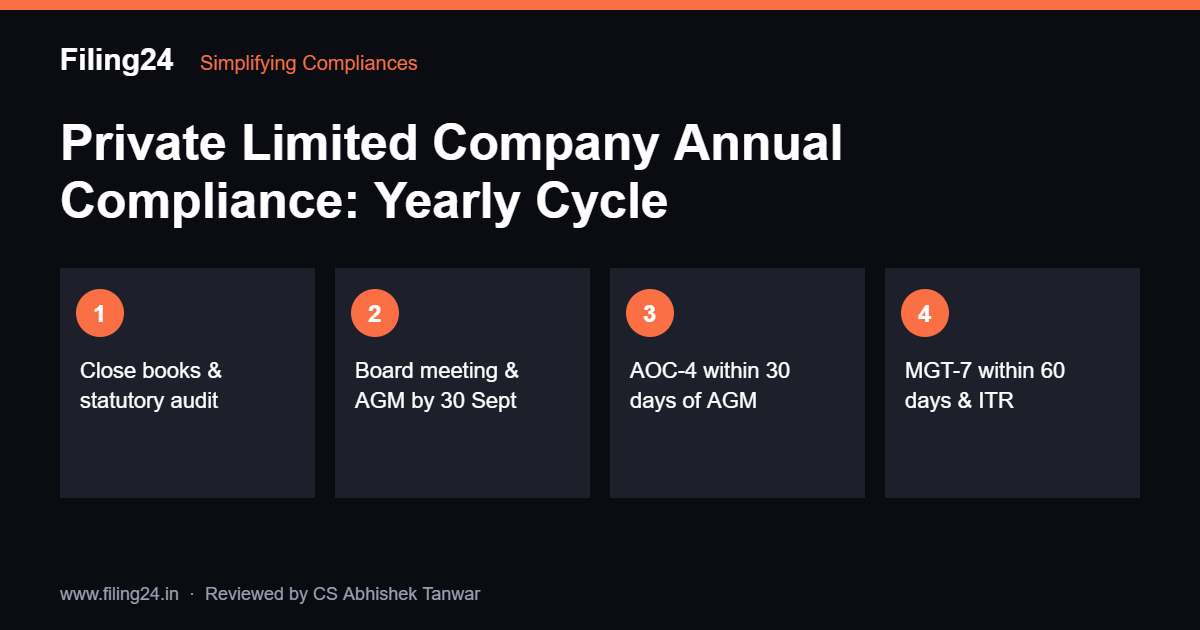
Quick answer: Private limited company annual compliance means the yearly filings every company must make, even with zero turnover: statutory audit, board meetings, an AGM by 30 September, AOC-4 (within 30 days of the AGM), MGT-7 or MGT-7A (within 60 days of the AGM), the income tax return by 31 October, plus DPT-3, MSME-1 and DIR-3 KYC where applicable. Missing a form costs ₹100 per day per form.
Why private limited company annual compliance matters
Many founders believe that if the company had no sales, nothing needs to be filed. That is the most expensive myth in company law. The Companies Act, 2013 requires every registered company to file its accounts and annual return every year, whether it earned ₹10 crore or nothing at all.
The cost of ignoring it builds quietly:
- Late fees with no cap: ₹100 per day for each of AOC-4 and MGT-7. A company that misses one full year owes around ₹73,000 in additional fees for just these two forms.
- Director disqualification: if a company does not file financial statements or annual returns for three continuous years, its directors are disqualified under Section 164(2) for five years and cannot be directors in any company.
- Strike-off: the ROC can remove the company from the register, freezing its bank account.
- Lost opportunities: banks, investors and large clients check your MCA filing status before they do business with you.
The good news: with a fixed calendar and an expert team, private limited company annual compliance is simple and predictable.
Annual ROC filings and due dates
| Compliance | Form | Due date (FY 2026-27) | Late fee |
|---|---|---|---|
| Financial statements | AOC-4 | Within 30 days of the AGM (29 Oct 2027) | ₹100 per day |
| Annual return | MGT-7 / MGT-7A | Within 60 days of the AGM (29 Nov 2027) | ₹100 per day |
| Auditor appointment | ADT-1 | Within 15 days of the AGM (when appointed) | As per fee rules |
| Annual General Meeting | – | By 30 September | Penalty under Section 99 |
| Return of deposits | DPT-3 | By 30 June | As per fee rules |
| Director KYC | DIR-3 KYC | Once every three financial years, by 30 June | ₹5,000 |
| MSME dues | MSME-1 | 30 April and 31 October | Penalty |
| Income tax return | ITR-6 | 31 October | Up to ₹5,000 + interest |
Dates are for a 31 March year end and an AGM on the last permitted date. If your AGM is earlier, AOC-4 and MGT-7 fall due earlier too. See the full ROC compliance calendar 2027.
Board meetings, registers and event-based compliances
Annual filings are only half of private limited company annual compliance. The law also expects the company to run its internal governance properly through the year.
Board meetings
- At least four board meetings every year, with not more than 120 days between two meetings.
- Small companies, OPCs and dormant companies need only one meeting in each half of the calendar year, with at least 90 days between them.
- Startups recognised by DPIIT and private companies often get further relaxations under the exemption notifications.
Disclosures and registers
- Each director gives MBP-1 (interest in other entities) and DIR-8 (non-disqualification) at the first board meeting of the financial year.
- Statutory registers of members, directors, charges and contracts must be kept up to date at the registered office.
- Minutes of every board and general meeting must be signed within 30 days.
Event-based filings
- DIR-12: appointment or resignation of a director, within 30 days. See add or remove a director.
- PAS-3: allotment of new shares, within 30 days.
- MGT-14: certain board and special resolutions, within 30 days.
- INC-22: change of registered office within the same city, within 30 days.
- CHG-1: creation or modification of a charge on a bank loan, within 30 days.
Private limited company annual compliance checklist (month by month)
Here is a simple calendar view of private limited company annual compliance for a company with a March year end. Print it, pin it, or let us track it for you.
| Month | What to do |
|---|---|
| April | First board meeting of the year: take MBP-1 and DIR-8 disclosures. File MSME-1 for October to March by 30 April. |
| May | Close the books for the previous year. Reconcile bank, GST and TDS data. |
| June | File DPT-3 by 30 June. Directors whose three-year KYC cycle falls due file DIR-3 KYC by 30 June. Start the statutory audit. |
| July – August | Finalise audit. Hold board meeting to approve accounts and board report. Send AGM notice at least 21 clear days before the AGM. |
| September | Hold the AGM by 30 September. Tax audit report (if applicable) by 30 September. |
| October | ADT-1 within 15 days of AGM (if auditor appointed). AOC-4 within 30 days of AGM. ITR-6 by 31 October. MSME-1 for April to September by 31 October. |
| November | MGT-7 or MGT-7A within 60 days of the AGM. |
| Every quarter | Board meeting (if required). TDS returns. GST returns as applicable. |
Private limited company annual compliance for small companies
Small companies enjoy lighter private limited company annual compliance. A private company is a small company if its paid-up capital is up to ₹10 crore and its turnover is up to ₹100 crore, after the limits were raised by the MCA. Holding and subsidiary companies, Section 8 companies and companies governed by special Acts cannot claim the status.
Benefits of being a small company:
- File the shorter annual return MGT-7A instead of MGT-7.
- Only two board meetings a year.
- No cash flow statement in the financial statements.
- No mandatory rotation of auditors.
- Lower additional fees for late filings in many cases.
Our team confirms your status every year before filing, so you never file the wrong form.
Private limited company annual compliance beyond the ROC
Private limited company annual compliance under the Companies Act is only one part of the picture. Depending on your business, you may also need to handle:
- GST: monthly or quarterly GSTR-1 and GSTR-3B, and the annual return GSTR-9 if turnover crosses the limit.
- TDS: deduct tax on salary, rent, professional fees and contracts, deposit it by the 7th of the next month and file quarterly returns.
- Advance tax: pay in four instalments (June, September, December and March) if tax liability is ₹10,000 or more.
- Payroll laws: PF and ESI once employee thresholds are crossed, and professional tax in states that levy it.
- Shops and establishments: registration or renewal under your state law.
Missing any of these creates interest and penalties that are often larger than the ROC fees. Our Growth Package bundles GST returns with ROC filings so that all your numbers match across portals, which is exactly what tax officers check first.
Dormant or inactive company?
If your company has no significant transactions, you can apply for dormant status under Section 455 by filing MSC-1. A dormant company files a simpler annual return (MSC-3) and has fewer obligations. Alternatively, if you no longer need the company, it can be closed through the fast-track exit route (STK-2) once all filings are up to date. Our experts will suggest the cheapest option for your situation.
Statutory audit and income tax return
Every private limited company must get its accounts audited by an independent Chartered Accountant, whatever its size. The audited balance sheet, profit and loss statement, cash flow statement (where applicable), notes and auditor’s report are then filed in AOC-4.
Companies file their income tax return in ITR-6 by 31 October. If the company has international or specified domestic transactions with related parties, the due date moves to 30 November with a transfer pricing report. A tax audit under Section 44AB is needed if turnover crosses the prescribed limit.
Getting the books in shape early is the secret to a smooth audit. Our Growth Package includes bookkeeping so that your audit starts in May, not in September.
How Filing24 handles private limited company annual compliance
- Kick-off call: we check your MCA master data, past filings and any pending defaults.
- Books and audit: we prepare or review your books and coordinate with the auditor (or arrange one).
- Board meeting and AGM: we draft the notice, board report, director disclosures and minutes.
- ROC filings: AOC-4, MGT-7/MGT-7A and ADT-1 are filed well before the due dates.
- Income tax return: ITR-6 is filed after the audit, with tax computation shared in advance.
- Reminders all year: DPT-3, MSME-1, DIR-3 KYC and event-based filings are tracked for you.
You can check your company’s filing status any time on the official MCA portal.
Missed private limited company annual compliance? How to fix it
If your company has not filed for one or more years, do not panic. The safest path is to catch up as quickly as possible, because the per-day fee keeps growing.
- Step 1: we list every pending form and calculate the additional fees.
- Step 2: pending audits and AGMs are completed, and forms are filed year by year.
- Step 3: where available, we use MCA condonation or settlement schemes to reduce fees.
- Step 4: if a director is disqualified or a DIN is deactivated, we guide you through the restoration process.
Just incorporated and want to start right? Begin with our post-incorporation compliance service or the first-year compliance package.
What our annual compliance service includes
- One dedicated expert for the entire year, reachable on WhatsApp and phone
- Compliance calendar customised to your company, with reminders 15 days before every due date
- Drafting of board report, AGM notice, minutes and resolutions
- Filing of AOC-4, MGT-7 or MGT-7A and ADT-1
- Coordination with your statutory auditor, or a qualified auditor arranged by us
- Income tax return filing with tax computation
- Annual health check of MCA master data, director KYC and charge records
Clients who sign up for private limited company annual compliance before 30 June get priority scheduling for their audit, so that the AGM and filings are completed well before the September rush.
Information we need from you
To complete private limited company annual compliance on time, we usually need the following by June:
- Bank statements for all company accounts for the full financial year
- Sales and purchase invoices, or access to your accounting software
- Expense bills, salary sheets and rent agreements
- Loan agreements and statements, including loans from directors
- Details of fixed assets bought or sold during the year
- GST and TDS return copies, if filed by another professional
- Any changes in directors, shareholders or registered office during the year
Do not worry if your records are not perfect. Our team will list what is missing and help you complete it step by step. The earlier we start, the more time there is to fix gaps before the audit.
Reviewed by CS Abhishek Tanwar, Filing24
Our guides are written and reviewed by the Filing24 compliance team and checked against the Companies Act, 2013, MCA notifications and official government portals. Last reviewed: 17 November 2026. Spotted something outdated? Message us on WhatsApp and we will correct it.
Never miss an ROC deadline again
Hand over your annual compliance to a dedicated expert. Fixed fee, reminders before every due date and filings done on time.