
Pvt Ltd vs LLP vs OPC vs Proprietorship
Pvt Ltd vs LLP vs OPC vs proprietorship: which is right for you?
Reviewed by CS Abhishek Tanwar, Filing24 · Last updated: 16 November 2026
Quick answer: In the Pvt Ltd vs LLP vs OPC vs proprietorship choice, pick a Private Limited Company if you want to raise funding, issue ESOPs or scale fast; an LLP if you are a partnership that wants limited liability with lighter compliance; an OPC if you are a solo founder who wants limited liability; and a sole proprietorship only for very small or test businesses, because the owner’s personal assets are fully at risk.
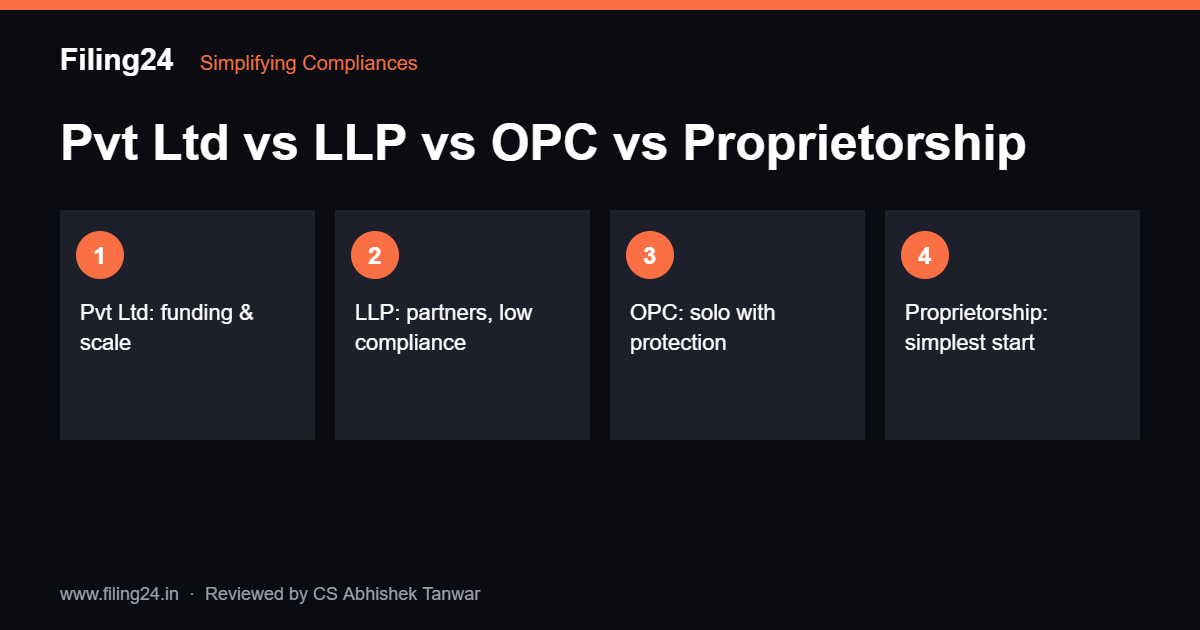
Pvt Ltd vs LLP vs OPC: comparison at a glance
| Feature | Private Limited | LLP | OPC | Proprietorship |
|---|---|---|---|---|
| Governing law | Companies Act, 2013 | LLP Act, 2008 | Companies Act, 2013 | No specific law |
| Minimum owners | 2 shareholders, 2 directors | 2 designated partners | 1 member + nominee | 1 owner |
| Maximum owners | 200 shareholders | No limit | 1 member | 1 owner |
| Liability | Limited to shares | Limited to contribution | Limited to shares | Unlimited |
| Separate legal entity | Yes | Yes | Yes | No |
| Equity funding | Best suited | Not practical for VCs | Convert first | Not possible |
| ESOPs | Yes | No | No | No |
| Income tax | 22% under Section 115BAA (plus surcharge and cess) or normal rates | 30% (plus surcharge and cess) | Same as company | Slab rates of owner |
| Statutory audit | Mandatory | Only above ₹40 lakh turnover or ₹25 lakh contribution | Mandatory | Tax audit if applicable |
| Annual ROC filings | AOC-4, MGT-7/7A | Form 8, Form 11 | AOC-4, MGT-7A | None |
| Ownership transfer | Easy (share transfer) | Needs partner consent and filings | Limited | Not possible |
| Foreign investment | Automatic route in most sectors | Allowed in sectors with 100% automatic route | NRIs who are Indian citizens only | Restricted |
| Filing24 all-inclusive price (excl. stamp duty) | ₹11,143 + stamp duty | On request | ₹9,143 + stamp duty | On request |
This table is the short answer to Pvt Ltd vs LLP vs OPC vs proprietorship. The sections below explain what each difference means in practice.
Pvt Ltd vs LLP vs OPC: the Private Limited Company
A Private Limited Company is the most popular structure for startups and growing businesses in India. It is a separate legal entity, so the company owns its assets, signs contracts and takes loans in its own name. Shareholders’ liability is limited to the unpaid amount on their shares.
Advantages
- Easy to raise equity from angels, venture funds and strategic investors.
- ESOPs can be offered to attract and retain talent.
- High credibility with banks, large customers and government buyers.
- Concessional corporate tax rate of 22% (plus surcharge and cess) under Section 115BAA.
- Shares can be transferred easily, which helps with succession and exits.
Disadvantages
- More compliance: statutory audit, board meetings, AGM, AOC-4 and MGT-7 every year.
- Higher annual compliance cost than an LLP or proprietorship.
- Dividends are taxed in the hands of shareholders, and profits can only be distributed through salary, dividend or buy-back.
Choose this if you plan to raise funds or build a large business. Register a Private Limited Company.
Pvt Ltd vs LLP vs OPC: the LLP
A Limited Liability Partnership combines the flexibility of a partnership with the limited liability of a company. Partners agree on profit sharing and management in an LLP agreement, and the LLP itself is a separate legal entity.
Advantages
- Lower compliance: audit is required only if turnover exceeds ₹40 lakh or contribution exceeds ₹25 lakh.
- No minimum capital and no restriction on the number of partners.
- Profit share received by partners is exempt from tax in their hands (the LLP pays tax).
- No dividend distribution issues; partners can withdraw profits more flexibly.
Disadvantages
- Venture capital funds rarely invest in LLPs.
- No ESOPs.
- Tax rate of 30% plus surcharge and cess, with no concessional regime like companies.
- Admitting or removing partners requires changes to the agreement and filings.
In the Pvt Ltd vs LLP vs OPC comparison, an LLP is often best for professional firms, consultancies, family partnerships and small businesses that do not plan to raise equity.
Pvt Ltd vs LLP vs OPC: the One Person Company
A One Person Company lets a single individual form a company with limited liability. It has one member, a nominee who takes over if the member dies or becomes incapable, and at least one director.
Advantages
- Limited liability and separate legal identity for a solo founder.
- No need to find a second shareholder.
- Fewer compliances than a Private Limited Company: no AGM, MGT-7A annual return, 180 days to file accounts.
- Same tax treatment as a company, including the 22% concessional regime.
- Can be converted into a Private Limited Company at any time.
Disadvantages
- Only one shareholder, so no equity funding or ESOPs until conversion.
- A person can form only one OPC.
- Cannot carry on non-banking financial investment activities.
- Audit and ROC filings are still mandatory every year.
Choose this if you are a freelancer, consultant or solo business owner who wants protection without a partner. Register an OPC or see our detailed OPC vs Private Limited comparison.
Sole proprietorship: simple but risky
A sole proprietorship is the simplest way to start. There is no separate registration under any company law. The business is identified by the owner’s PAN, and registrations such as GST, Udyam, shops and establishments or a current account in the trade name give it a working identity.
Advantages
- Very easy and cheap to start.
- Minimal compliance: income tax return of the owner, and GST if registered.
- Full control and all profits belong to the owner.
Disadvantages
- Unlimited liability: the owner’s house, savings and other assets can be used to pay business debts.
- Cannot raise equity or bring in partners without changing structure.
- Business ends with the owner; succession is difficult.
- Lower credibility with large clients and banks.
- Profits are taxed at the owner’s slab rates, which can go up to 30% plus surcharge.
A proprietorship is fine to test an idea, but most businesses outgrow it quickly. When you compare Pvt Ltd vs LLP vs OPC vs proprietorship, the proprietorship wins only on simplicity.
Pvt Ltd vs LLP vs OPC: tax comparison
Tax is often the deciding factor. Here is a simplified view for a business earning ₹20 lakh profit, ignoring deductions and surcharge thresholds:
| Structure | How profit is taxed | Approximate effective rate on business profit |
|---|---|---|
| Private Limited (Section 115BAA) | 22% + 10% surcharge + 4% cess at company level; dividends taxed again in shareholders’ hands | About 25.17% at company level |
| LLP | 30% + cess (surcharge if income above ₹1 crore); partner profit share exempt | About 31.2% |
| OPC | Same as Private Limited | About 25.17% at company level |
| Proprietorship | Owner’s slab rates (new or old regime) | Depends on total income; can approach 30% plus cess at higher levels |
The real answer depends on how much profit you withdraw, salaries paid to founders, and whether profits are reinvested. A company that reinvests profits can benefit from the lower corporate rate, while an LLP may suit businesses that distribute most profits to partners. Speak to our tax experts before deciding Pvt Ltd vs LLP vs OPC purely on tax.
Pvt Ltd vs LLP vs OPC: compliance and annual cost
The ongoing cost of compliance matters as much as the one-time registration fee.
| Requirement | Private Limited | LLP | OPC | Proprietorship |
|---|---|---|---|---|
| Statutory audit | Every year | Above thresholds only | Every year | Tax audit if applicable |
| Board meetings | 4 a year (2 for small companies) | None | 2 a year if more than 1 director | None |
| AGM | Every year | None | None | None |
| Annual ROC forms | AOC-4, MGT-7/7A | Form 8, Form 11 | AOC-4, MGT-7A | None |
| Income tax return | ITR-6 | ITR-5 | ITR-6 | ITR-3 or ITR-4 |
| Typical annual professional cost | Higher | Lower | Moderate | Lowest |
For a small business without funding plans, the LLP or OPC route keeps costs down. For a business that wants to scale, the extra compliance of a Private Limited Company is a worthwhile investment. See our annual compliance and OPC compliance plans.
Pvt Ltd vs LLP vs OPC: a simple decision guide
- Will you raise money from investors in the next two to three years? If yes, choose a Private Limited Company.
- Do you want to offer ESOPs to employees? If yes, choose a Private Limited Company.
- Are you a solo founder who wants limited liability? Choose an OPC now and convert later if needed.
- Are you two or more partners in a professional or service firm with no funding plans? An LLP is usually the most efficient.
- Are you testing an idea with very low risk and small revenue? A proprietorship may be enough for now, but plan to upgrade.
Most of the founders who ask us about Pvt Ltd vs LLP vs OPC end up choosing a Private Limited Company because it keeps every option open. If you are not sure, the safest default for a growing business is a Private Limited Company.
Pvt Ltd vs LLP vs OPC for common business types
| Business | Best fit | Why |
|---|---|---|
| Tech startup | Private Limited | Funding and ESOPs |
| D2C or e-commerce brand | Private Limited | Funding, marketplace credibility, brand ownership |
| CA, CS, architect or consulting firm | LLP | Partners, lower compliance, professional rules |
| Freelancer or solo consultant | OPC | Limited liability without a partner |
| Family manufacturing business | Private Limited | Bank finance, succession, credibility with buyers |
| Small local shop | Proprietorship | Simplicity, until it grows |
| Non-profit or charity | Section 8 company | Tax exemptions and credibility with donors |
Switching structures later
- Proprietorship to company: incorporate a company and transfer the business through an agreement.
- OPC to Private Limited: voluntary conversion is allowed at any time by adding members and directors.
- Partnership firm to LLP or company: possible through conversion under the LLP Act or Companies Act.
- LLP to company: possible under the Companies Act, but more complex.
Switching is possible, but it costs time and money. Choosing well in the Pvt Ltd vs LLP vs OPC decision saves you from a second restructuring later.
Pvt Ltd vs LLP vs OPC: registration process and time
| Point | Private Limited | LLP | OPC | Proprietorship |
|---|---|---|---|---|
| Registration form | SPICe+ (INC-32) | FiLLiP | SPICe+ (INC-32) | No ROC form |
| Name reservation | SPICe+ Part A | RUN-LLP | SPICe+ Part A | Not required |
| Constitution document | MoA and AoA | LLP agreement (filed in Form 3) | MoA and AoA | None |
| Typical time | 7–10 working days | 10–15 working days | 7–10 working days | 1–7 days for GST or Udyam |
| Government fee | Nil up to ₹15 lakh capital, plus stamp duty | Based on contribution, plus stamp duty on agreement | Nil up to ₹15 lakh capital, plus stamp duty | Nil for most registrations |
Registration time is similar for a company and an OPC. LLPs take slightly longer because the LLP agreement is filed separately after incorporation, within 30 days.
Common mistakes founders make in the Pvt Ltd vs LLP vs OPC decision
- Choosing an LLP and then raising funds: investors usually ask for a conversion to a company, which costs time and money.
- Staying a proprietorship too long: as contracts grow, unlimited liability becomes a serious personal risk.
- Choosing an OPC when a co-founder is likely to join soon: a Private Limited Company from the start avoids conversion later.
- Deciding only on registration cost: the difference in registration fee is small compared with years of compliance, tax and funding implications.
- Ignoring professional rules: some professions, such as chartered accountants and advocates, have specific rules about which structures they can use.
Why talk to an expert before choosing
Every business is different. Your plans for funding, the number of founders, expected profits, the industry you operate in and even your clients’ preferences all affect the right answer to Pvt Ltd vs LLP vs OPC vs proprietorship. A short conversation with an expert can save you years of extra cost or a painful restructuring later.
Filing24 offers a free 15-minute consultation. We will ask a few questions about your business and recommend the structure that fits, along with the expected registration and annual compliance cost. You can read the official rules on the Ministry of Corporate Affairs website.
Reviewed by CS Abhishek Tanwar, Filing24
Our guides are written and reviewed by the Filing24 compliance team and checked against the Companies Act, 2013, MCA notifications and official government portals. Last reviewed: 17 November 2026. Spotted something outdated? Message us on WhatsApp and we will correct it.
Not sure which structure to choose?
Book a free 15-minute call. Our expert will recommend the right structure for your business and plans.