
AOC-4 Filing
Simplifying Business Needs!
AOC-4 Filing Packages
Documents Required

Director PAN & DSC

Audited Balance Sheet & P&L

Auditor Report

Board Report

AGM Details


AOC-4 filing: how companies file their annual accounts
Reviewed by CS Abhishek Tanwar, Filing24 · Last updated: 16 November 2026
Quick answer: AOC-4 filing is the submission of a company’s audited financial statements to the Registrar of Companies under Section 137 of the Companies Act, 2013. Form AOC-4 is due within 30 days of the AGM (29 October for an AGM on 30 September) and within 180 days of the year end for an OPC. It includes the balance sheet, profit and loss statement, notes, auditor’s report and board’s report. Late filing costs ₹100 per day.
What is Form AOC-4?
Every company must make its annual financial statements available to the public through the MCA. Form AOC-4 is the e-form used for this. It is a structured form, not just an upload: key figures from the balance sheet and profit and loss statement are entered in fields, and the full signed financial statements, auditor’s report and board’s report are attached.
AOC-4 filing is what makes your company’s financial performance visible to banks, investors, credit rating agencies and government departments. A missing or late AOC-4 is one of the first red flags they notice.
Types of AOC-4
| Form | Who files it |
|---|---|
| AOC-4 | Most companies, including private companies and OPCs |
| AOC-4 CFS | Companies that must prepare consolidated financial statements (with subsidiaries, associates or joint ventures) |
| AOC-4 XBRL | Listed companies and their Indian subsidiaries, companies with paid-up capital of ₹5 crore or more, turnover of ₹100 crore or more, and companies preparing Ind AS financial statements |
| AOC-4 NBFC (Ind AS) | NBFCs that follow Ind AS |
Most small and medium private companies file the regular AOC-4. Our experts confirm the right form before AOC-4 filing begins.
AOC-4 filing due dates
| Company type | Due date | For FY 2026-27 |
|---|---|---|
| Private and public companies | Within 30 days of the AGM | 29 October 2027 (AGM on 30 September) |
| One Person Company | Within 180 days of the end of the financial year | 27 September 2027 |
| AGM not held | Within 30 days of the last date on which the AGM should have been held | 29 October 2027 |
If your AGM is held earlier, for example on 15 September, the AOC-4 filing deadline moves earlier to 15 October. See all dates in our ROC compliance calendar 2027.
What is attached in AOC-4 filing?
- Balance sheet with notes to accounts
- Statement of profit and loss
- Cash flow statement (not required for OPCs, small companies and dormant companies)
- Statement of changes in equity (where applicable)
- Auditor’s report, including CARO report where applicable
- Board’s report with annexures
- Form AOC-2 for related party transactions not in the ordinary course or not at arm’s length
- CSR report if CSR provisions apply
- Statement of subsidiaries in Form AOC-1 where applicable
The form also captures key figures such as share capital, reserves, borrowings, fixed assets, revenue, profit and auditor details. These must match the signed financial statements exactly.
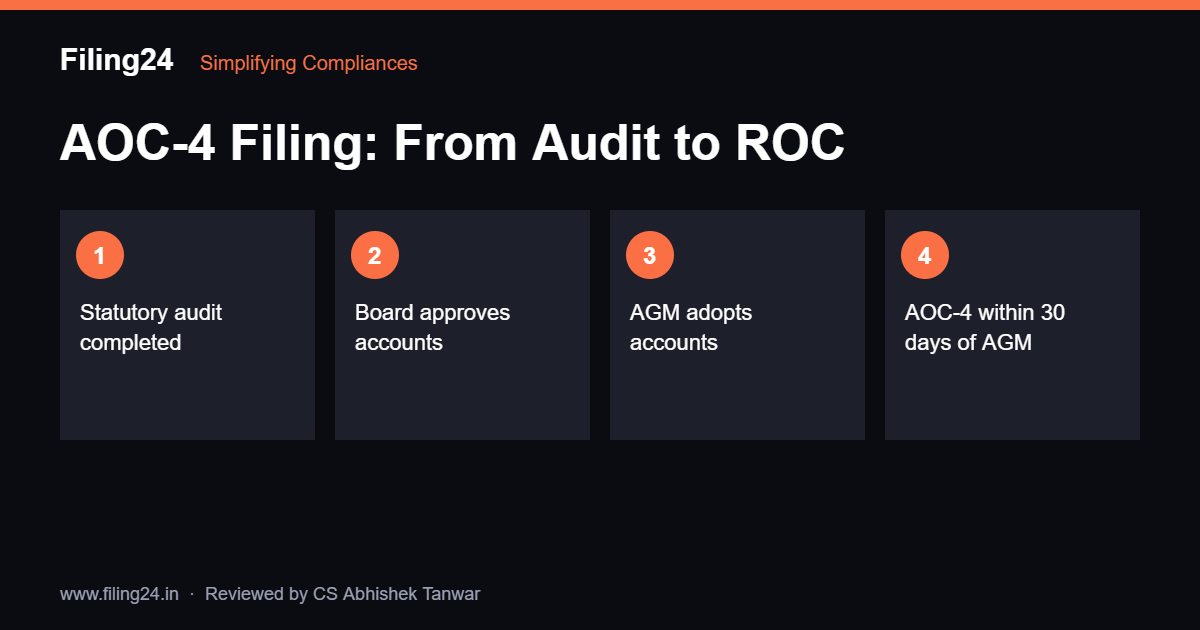
Step-by-step AOC-4 filing process
- Finalise accounts: close books and prepare the financial statements as per Schedule III.
- Statutory audit: the auditor completes the audit and signs the report.
- Board meeting: the board approves the financial statements and board’s report, and authorises signatories.
- AGM: shareholders adopt the financial statements.
- Prepare the form: enter figures in AOC-4, attach the documents and link the auditor’s details (SRN of ADT-1 where applicable).
- Certify and sign: a director signs with DSC and a practising professional certifies the form.
- Pay and submit: pay the fee (plus additional fee if late) and submit on the MCA V3 portal.
Accurate AOC-4 filing depends on the earlier steps being done properly. That is why our packages include board report drafting and AGM documents.
Late fees and penalties
If AOC-4 is filed late, an additional fee of ₹100 per day applies, with no upper limit. One year of delay costs about ₹36,500 for AOC-4 alone. In addition:
- Under Section 137, the company can face a penalty of ₹10,000 plus ₹100 per day of continued default, up to ₹2 lakh.
- The managing director or other responsible officers can face a penalty of ₹10,000 plus ₹100 per day, up to ₹50,000.
- Non-filing for three continuous years leads to director disqualification under Section 164(2).
Timely AOC-4 filing is far cheaper than any of these consequences.
AOC-4 filing for companies with no business
A company with no revenue and no transactions still needs a statutory audit and AOC-4 filing every year. The financial statements will show the share capital, preliminary expenses, bank balance and any expenses such as audit fees and ROC fees. Skipping AOC-4 because “nothing happened” is one of the most common reasons small companies end up with large late fees and disqualified directors.
If the company is likely to stay inactive for a long time, consider applying for dormant status under Section 455, or closing it through the fast-track exit route. Both require filings to be up to date first.
Common errors in AOC-4 filing
- Figures not matching: numbers entered in the form must exactly match the signed financial statements, or the form can be marked defective.
- Old auditor details: the auditor’s membership number, firm registration number and ADT-1 reference must be correct.
- Missing board report: the board’s report is a mandatory attachment, even for small companies.
- Wrong form type: filing AOC-4 instead of AOC-4 XBRL, or vice versa.
- Related party transactions ignored: transactions with directors and their relatives must be disclosed, with AOC-2 where required.
- Filing before the AGM: AOC-4 must reflect accounts adopted at the AGM, so the AGM date and details must be correct.
Our team cross-checks every field during AOC-4 filing to avoid defects and resubmissions.
AOC-4 filing and MGT-7: file them together
AOC-4 and the annual return (MGT-7 or MGT-7A) are the two core annual filings. AOC-4 is due within 30 days of the AGM and the annual return within 60 days. Filing them together, right after the AGM, means you only gather documents once and both forms show consistent data. Our AOC-4 + MGT-7 package does exactly that.
For the full yearly cycle, including audit, AGM and income tax return, see private limited company annual compliance or OPC annual compliance.
Documents we need for AOC-4 filing
- Signed audited financial statements (balance sheet, P&L, notes, cash flow where applicable)
- Signed auditor’s report and CARO report (if applicable)
- Board’s report with annexures
- Date and details of the board meeting and AGM
- Details of related party transactions
- DSC of the authorised director
You can view the company’s past AOC-4 filings on the official MCA portal through the public documents service.
Board’s report: the attachment most companies get wrong
The board’s report under Section 134 is a mandatory attachment in AOC-4 filing. Small companies and OPCs can use an abridged version, but it must still cover key points such as:
- Financial summary and state of the company’s affairs
- Amount transferred to reserves and dividend recommended, if any
- Material changes after the year end
- Details of directors appointed or resigned during the year
- Number of board meetings held
- Directors’ responsibility statement
- Particulars of loans, guarantees and investments under Section 186
- Related party transactions in Form AOC-2
- Explanation on any qualification in the auditor’s report
A weak or incomplete board report can lead to queries from the ROC. Our team drafts it in the correct format as part of every AOC-4 package.
Timeline and fees
| Item | Detail |
|---|---|
| Filing24 professional fee | ₹3,999 for AOC-4 filing (₹7,999 with MGT-7) |
| Government filing fee | ₹200 to ₹600 based on authorised capital (normal fee) |
| Additional fee for delay | ₹100 per day |
| Time to file | 1–2 working days after we receive audited accounts |
Missed the deadline already? We file pending AOC-4 forms for past years too, and check whether any MCA relief scheme can lower your additional fees.
How AOC-4 filing affects loans, tenders and investors
Your filed financial statements are public. That has practical consequences:
- Bank loans: banks pull your AOC-4 data from the MCA to check revenue, profit, net worth and existing borrowings. A missing year can stall a loan or overdraft renewal.
- Government tenders: most tenders ask for audited financials for the last two or three years, and buyers often verify them against MCA records.
- Investors and acquirers: due diligence starts with the MCA master data and financial filings. Gaps raise questions about governance.
- Credit ratings and vendor onboarding: large customers and rating agencies use MCA data to assess your financial health.
Treat AOC-4 filing as part of your company’s reputation, not just a legal formality. Filing on time, with clean and consistent numbers, builds credibility with everyone who checks your company.
Tips for a smooth AOC-4 every year
- Start bookkeeping reconciliation in April, not September.
- Fix the audit dates with your auditor by June.
- Hold the AGM a few days before 30 September to leave buffer for filing.
- File AOC-4 and MGT-7 together immediately after the AGM.
Reviewed by CS Abhishek Tanwar, Filing24
Our guides are written and reviewed by the Filing24 compliance team and checked against the Companies Act, 2013, MCA notifications and official government portals. Last reviewed: 17 November 2026. Spotted something outdated? Message us on WhatsApp and we will correct it.
File your AOC-4 on time, every time
Share your audited accounts and AGM details. We will review, certify and complete your AOC-4 filing before the due date.