
OPC Annual Compliance
Simplifying Business Needs!
OPC Compliance Packages
Documents Required

Director PAN & DSC

Office & Bank Details

Sales & Purchase Data

Expense Bills

Previous Year Filings


OPC annual compliance explained in plain language
Reviewed by CS Abhishek Tanwar, Filing24 · Last updated: 16 November 2026
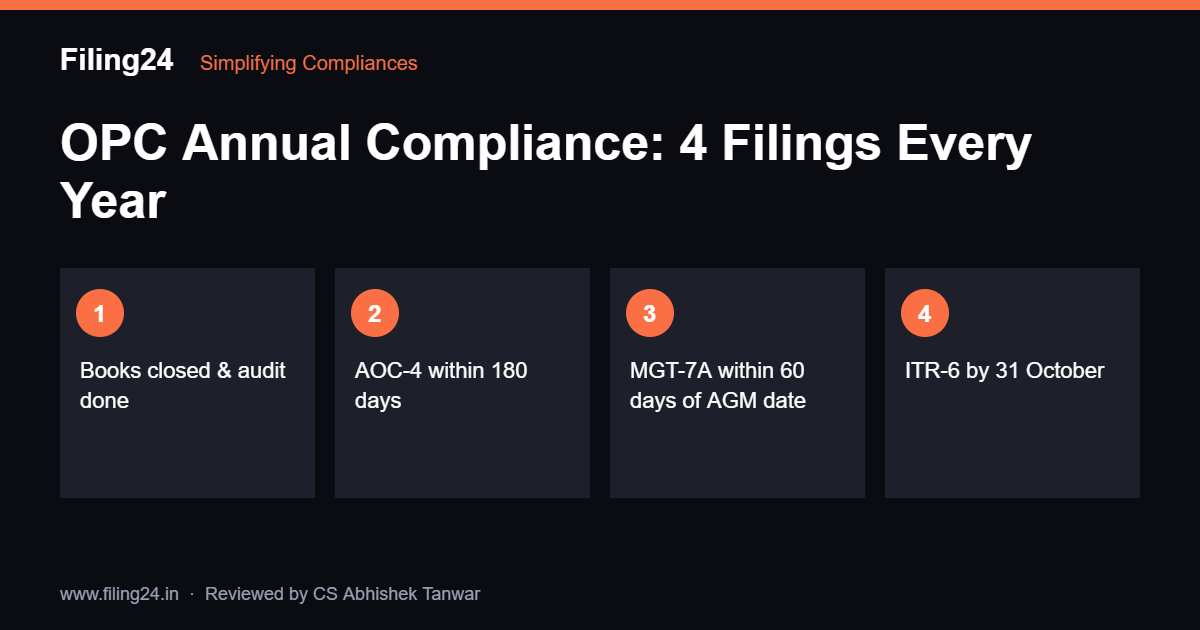
Quick answer: OPC annual compliance covers four core tasks every year: a statutory audit by a Chartered Accountant, Form AOC-4 within 180 days of the year end (27 September), Form MGT-7A within 60 days of the date the AGM would have been due, and the ITR-6 income tax return by 31 October. An OPC does not need to hold an AGM. Late ROC filings cost ₹100 per day per form.
What is OPC annual compliance?
A One Person Company gets many relaxations, but it is still a company registered with the Ministry of Corporate Affairs. That means it has to keep proper books, get them audited and report to the Registrar of Companies every year. These yearly tasks together are called OPC annual compliance.
Many solo founders assume that because there is only one owner, there is nothing to file. In reality, the MCA system automatically tracks missing forms, and late fees start running the day after a due date. The upside is that OPC annual compliance is much lighter than for a regular private limited company, and with the right partner it takes very little of your time.
OPC annual compliance calendar and due dates
| Compliance | Form | Due date | Late fee |
|---|---|---|---|
| Financial statements | AOC-4 | Within 180 days of year end (27 September) | ₹100 per day |
| Annual return | MGT-7A | Within 60 days from the date the AGM would have been due (about 29 November) | ₹100 per day |
| Auditor appointment | ADT-1 | Within 15 days of appointment | As per fee rules |
| Income tax return | ITR-6 | 31 October | Up to ₹5,000 plus interest |
| Director KYC | DIR-3 KYC | Once every three financial years, by 30 June | ₹5,000 |
| Return of deposits / loans | DPT-3 | 30 June (if applicable) | As per fee rules |
| MSME dues | MSME-1 | 30 April and 31 October (if applicable) | Penalty |
Dates are for a 31 March year end. See every company deadline in our ROC compliance calendar 2027.
Relaxations that make OPC annual compliance lighter
- No AGM: Section 96 exempts an OPC from holding an Annual General Meeting. Resolutions are simply recorded in the minute book and signed by the member.
- More time for accounts: AOC-4 is due 180 days from the year end instead of 30 days from the AGM.
- Shorter annual return: an OPC files MGT-7A, the abridged annual return, signed by the director without certification by a practising Company Secretary.
- Fewer board meetings: an OPC with one director does not need board meetings. With more directors, one meeting in each half of the calendar year with a 90-day gap is enough.
- No cash flow statement: the financial statements of an OPC need not include a cash flow statement.
- Signing: financial statements can be signed by a single director.
These relaxations are the reason OPC annual compliance usually costs less than half of what a regular company pays.
What OPC annual compliance does not exempt you from
Some obligations apply to an OPC exactly as they apply to any other company. These are the ones founders most often miss:
- Statutory audit: every OPC must appoint a Chartered Accountant as auditor and get its accounts audited every year, with no turnover threshold.
- Income tax return: ITR-6 is compulsory even if the OPC made a loss or had no income.
- Director disclosures: MBP-1 (interest in other entities) and DIR-8 (non-disqualification) must be taken every year.
- Statutory registers: register of members, directors and charges must be maintained.
- Event-based filings: change of director (DIR-12), registered office (INC-22), capital (SH-7) or nominee (INC-4) within the time limits.
Step-by-step OPC annual compliance process with Filing24
- April – May: data collection. We collect bank statements, invoices and expense details, or connect to your accounting software.
- June: books and DPT-3. Books are finalised, director KYC is checked and DPT-3 is filed if needed.
- July – August: statutory audit. We coordinate with your auditor or arrange a qualified CA firm, and share draft accounts with you for approval.
- September: AOC-4. The audited financial statements are filed with the ROC before 27 September.
- October: ITR-6. The income tax return is filed by 31 October with tax computation shared in advance.
- November: MGT-7A. The annual return is filed, and you receive a compliance certificate summary for your records.
Throughout the year, you receive reminders on WhatsApp and email. One dedicated expert handles your OPC annual compliance, so you never have to explain your business twice.
Penalties for missing OPC annual compliance
The cost of delay adds up quickly. For an OPC that misses both AOC-4 and MGT-7A for one year, the additional fees alone are around ₹73,000 (₹100 per day for each form). On top of that:
- The company and its officers can face penalties under Sections 92 and 137 of the Companies Act.
- If filings are missed for three continuous years, the director is disqualified for five years under Section 164(2), and their DIN is deactivated.
- The ROC may start strike-off proceedings, which freezes the company bank account.
- Banks and large clients may refuse to work with a company that shows “non-compliant” on the MCA portal.
If your OPC is already behind, talk to us. We regularly help companies catch up on several years of pending filings and use any MCA relief scheme that is open at the time.
OPC annual compliance vs private limited company compliance
| Requirement | OPC | Private Limited Company |
|---|---|---|
| AGM | Not required | Mandatory by 30 September |
| Board meetings | None with one director; otherwise 2 a year | 4 a year (2 for small companies) |
| AOC-4 due date | 180 days from year end | 30 days from AGM |
| Annual return | MGT-7A | MGT-7 or MGT-7A |
| Cash flow statement | Not required | Required (except small companies) |
| Statutory audit | Mandatory | Mandatory |
| Income tax return | ITR-6 | ITR-6 |
If your OPC is growing and you plan to bring in a co-founder or investor, you can convert it into a private limited company at any time. Compliance will increase slightly, but you gain flexibility to issue shares. Read our OPC vs Private Limited guide or see private limited company annual compliance.
Taxes and other laws alongside OPC annual compliance
ROC filings are only one part of running an OPC. Depending on your business, you also need to keep an eye on:
- GST returns: GSTR-1 and GSTR-3B monthly or quarterly, and the annual return if your turnover crosses the limit.
- TDS: tax deducted on rent, professional fees, contractor payments and salary must be deposited by the 7th of the next month, with quarterly returns.
- Advance tax: four instalments in June, September, December and March if the tax liability is ₹10,000 or more.
- Director remuneration: salary paid to you as director is a deductible expense for the OPC and taxable in your hands, so plan it in advance.
Our Growth Package combines bookkeeping, GST returns and OPC annual compliance so that your numbers match on every government portal.
Information checklist for your OPC annual compliance
- Bank statements of all OPC accounts for the full year
- Sales and purchase invoices or accounting software access
- Expense bills, rent agreement and salary records
- Loan details, including any loan from the director
- Details of assets bought or sold
- GST and TDS return copies
- Any change in director, nominee, address or capital during the year
You can check your OPC’s current filing status on the official Ministry of Corporate Affairs portal using the company master data service.
Why OPC owners trust Filing24
- Fixed annual fee with no surprise charges.
- One dedicated expert who knows your business.
- Reminders 15 days before every deadline on WhatsApp and email.
- Audit coordination included, with qualified CA firms available if you do not have an auditor.
- Past-year clean-up for OPCs that have missed earlier filings.
Recently registered? Start with our post-incorporation compliance service, then move to yearly OPC annual compliance.
Common mistakes in OPC annual compliance
- Using the wrong due date: many OPCs copy the private company calendar and file AOC-4 late or early. An OPC gets 180 days from the year end.
- Skipping the audit for “no business” years: an audit is required even if the OPC had no transactions.
- Mixing personal and business money: paying personal expenses from the company account creates problems in the audit and in income tax scrutiny. Pay yourself a salary or reimbursement instead.
- Ignoring director loans: money you put into the OPC or take out must be recorded properly, and may need disclosure in DPT-3.
- Old nominee details: if your nominee changes, file Form INC-4 within the time limit.
- Not updating KYC: under the new rules, changes in your mobile number, email or address must be updated on the MCA portal within 30 days.
Each of these mistakes is easy to avoid with a simple yearly routine. That is exactly what our OPC annual compliance service gives you: a clear checklist, timely reminders and a professional who checks everything before it is filed.
How long does OPC annual compliance take?
If your books are up to date, the full OPC annual compliance cycle usually takes three to four weeks of work spread across the year: one to two weeks for the audit, a few days for AOC-4 and ITR-6, and a day or two for MGT-7A. Your own involvement is limited to sharing documents, approving the draft accounts and signing digitally.
If your books are not ready, we recommend our Growth Package, where we maintain your accounts through the year. This makes the audit faster and gives you monthly visibility of your profit, GST and cash position.
Reviewed by CS Abhishek Tanwar, Filing24
Our guides are written and reviewed by the Filing24 compliance team and checked against the Companies Act, 2013, MCA notifications and official government portals. Last reviewed: 17 November 2026. Spotted something outdated? Message us on WhatsApp and we will correct it.
Keep your OPC 100% compliant
Fixed fee, one expert and reminders before every due date. Focus on your business while we handle OPC annual compliance.