
DIR-3 KYC Filing
Simplifying Business Needs!
DIR-3 KYC Packages
Documents Required

PAN Card

Aadhaar Card

Address Proof

Director DSC

Personal Email & Phone


DIR-3 KYC: what changed in 2026
Reviewed by CS Abhishek Tanwar, Filing24 · Last updated: 16 November 2026
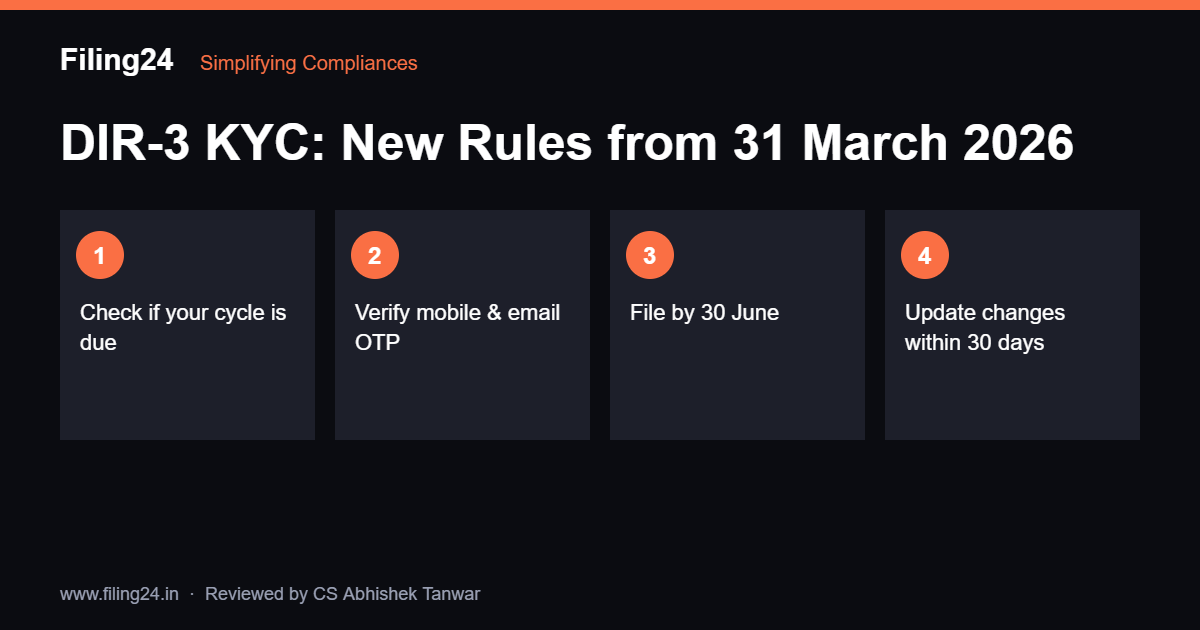
Quick answer: DIR-3 KYC is the know-your-customer filing for every person holding a Director Identification Number (DIN). From 31 March 2026, it is no longer annual: directors complete DIR-3 KYC once every three financial years, by 30 June, and must update any change in mobile number, email or residential address within 30 days. If KYC is not filed, the DIN is deactivated and can be reactivated only with a ₹5,000 fee.
What is DIR-3 KYC?
The Ministry of Corporate Affairs introduced DIR-3 KYC in 2018 to clean up its director database. Many DINs belonged to people who could not be traced, which made it easy to set up shell companies. KYC links every DIN to a verified PAN, Aadhaar, personal mobile number, email and address.
Every individual who holds a DIN must complete DIR-3 KYC, whether they are an active director, a director of a struck-off company, or have never been appointed in any company. Even disqualified directors must file it.
The new three-year DIR-3 KYC cycle
Until 2025, DIR-3 KYC had to be filed every year by 30 September. The Companies (Appointment and Qualification of Directors) Amendment Rules, 2025, effective from 31 March 2026, changed this:
- Frequency: once every three consecutive financial years, instead of every year.
- Due date: on or before 30 June following the financial year in which the KYC falls due.
- Event-based updates: any change in personal mobile number, email address or residential address must be reported within 30 days of the change.
- Single web form: the web-based DIR-3 KYC form is used for filings and updates.
Because the rules are new, the exact year in which a particular director’s next KYC is due depends on their last filing. Our team checks each DIN on the MCA portal before filing, so you do not file early or miss your window.
Key facts at a glance
| Who files | Every individual holding a DIN, including disqualified directors |
|---|---|
| Frequency | Once every three financial years (from 31 March 2026) |
| Due date | 30 June of the year in which KYC falls due |
| Updates | Within 30 days of change in mobile, email or address |
| Late fee | ₹5,000 per DIN |
| Consequence of non-filing | DIN marked “Deactivated due to non-filing of KYC” |
Step-by-step DIR-3 KYC process
- Check your DIN status on the MCA portal to see whether KYC is due or the DIN is deactivated.
- Keep your DSC ready. The e-form version needs a valid Class 3 DSC of the director. If it has expired, get a new one first.
- Verify mobile and email. One-time passwords are sent to your personal mobile number and email. These must be unique to you and not shared with another director.
- Fill in personal details. Name, father’s name, date of birth, nationality, PAN, Aadhaar, passport (for foreign nationals) and residential address, exactly as in your documents.
- Certification. The e-form is certified by a practising CA, CS or CMA where required.
- Submit. The KYC is processed and the DIN status updates to “Approved”.
With Filing24, DIR-3 KYC is usually completed in one sitting of 10–15 minutes, with you only sharing the OTPs.
DIR-3 KYC e-form vs web form
| Point | DIR-3 KYC e-form | DIR-3 KYC web |
|---|---|---|
| Used for | First-time KYC, or when details have changed | Confirming existing details, or event-based updates as notified |
| DSC required | Yes | Login and OTP based |
| Professional certification | Yes | Not required |
| Time | 15–20 minutes | 5 minutes |
Following the 2026 amendment, the MCA has moved towards a single web-based DIR-3 KYC for filings and updates. The exact mode applicable to you will be visible on the MCA portal when you log in. Our team chooses the right one for you.
What happens if you miss DIR-3 KYC?
- Your DIN is marked “Deactivated due to non-filing of DIR-3 KYC”.
- You cannot sign any MCA form as a director until it is reactivated.
- Companies cannot file forms where your DIN is required, which can delay their annual filings.
- You cannot be appointed as a director in any new company.
- To reactivate, you must file DIR-3 KYC with a fee of ₹5,000.
The DIN itself is not cancelled, so reactivation is simple once the fee is paid. But the disruption to your companies can be costly, especially near annual filing deadlines.
Who must file and who is exempt
Must file:
- Every individual who holds a DIN, whether or not they are currently a director
- Directors of active, inactive, dormant or struck-off companies
- Disqualified directors
- Foreign nationals holding a DIN
- Designated partners of LLPs who hold a DIN (they use the same DIN)
Not required:
- Individuals whose DIN has been surrendered or cancelled
- People who never applied for a DIN, such as company secretaries without a directorship
Documents and details needed
- PAN (mandatory for Indian nationals)
- Aadhaar (for Indian residents) linked to mobile for OTP
- Passport (mandatory for foreign nationals; optional for Indians)
- Residential address proof, such as a bank statement or utility bill
- Personal mobile number and email that are not used by any other director
- Valid Class 3 DSC (for the e-form)
Name, father’s name and date of birth must match exactly across PAN, Aadhaar and your DIN record. If they do not, the DIN details must be corrected first through Form DIR-6.
Common DIR-3 KYC mistakes
- Using a company or shared email: the MCA rejects KYC if the email or mobile is already linked to another DIN.
- Mismatch in names: a missing middle name or spelling difference between PAN and Aadhaar causes errors.
- Expired DSC: check the DSC validity before you start.
- Assuming it is still annual: under the 2026 rules the cycle is three years, but updates within 30 days are mandatory. Do not ignore address or phone changes.
- Waiting until June: the portal slows down close to 30 June. File early in your due year.
Why use Filing24 for DIR-3 KYC
- DIN status check before filing, so you know if KYC is actually due
- Same-day filing with OTP support over a call
- New DSC issued online if yours has expired
- Reactivation of deactivated DINs, including late fee handling
- Reminders for your next three-year cycle and event-based updates
Directors who use our annual compliance service get DIR-3 KYC tracking included. Changing directors instead? See add or remove a director and DIR-12 filing.
Old rules vs new rules
| Point | Before 31 March 2026 | From 31 March 2026 |
|---|---|---|
| Frequency | Every financial year | Once every three financial years |
| Due date | 30 September | 30 June |
| Change in contact details | Updated at next annual KYC | Within 30 days of the change |
| Late fee | ₹5,000 | ₹5,000 |
| Consequence of non-filing | DIN deactivated | DIN deactivated |
The shift reduces the yearly burden on directors, but the 30-day update rule means you can no longer wait for the next annual filing to fix a changed phone number or address. Keep your details current throughout the three-year cycle.
The notification and current rules are available on the official Ministry of Corporate Affairs website. Because these rules are recent, always confirm your due date on the portal or with our team before relying on a specific date.
Reactivating a deactivated DIN
If your DIN is already deactivated, here is how it is restored:
- Check the DIN status and the reason for deactivation.
- Get or renew your DSC.
- File DIR-3 KYC with the late fee of ₹5,000.
- Once approved, the DIN status returns to “Approved” and you can sign forms again.
If the DIN is also disqualified due to non-filing by a company, KYC alone will not remove the disqualification. That requires the company’s pending filings to be completed or other legal remedies. Our team can assess the situation and guide you.
DIR-3 KYC for foreign and NRI directors
Foreign nationals must provide a passport as identity proof, and their address proof should be notarised and apostilled or consularised. The OTP can be sent to an overseas mobile number. NRIs who are Indian citizens can use PAN and Aadhaar if they have them. Our team handles international directors regularly and can complete DIR-3 KYC over a video call.
How companies should manage director KYC
For companies, director KYC is not just a personal task of each director. A deactivated DIN can block important filings: AOC-4, MGT-7, DIR-12 and charge forms all need an active director’s DSC. A simple routine keeps you safe:
- Keep a list of all directors with their DIN, DSC expiry date and last KYC filing year.
- Ask directors to inform the company secretary or compliance partner whenever they change their phone, email or address.
- Check DIN status on the MCA portal before every major filing season.
- Renew DSCs at least a month before they expire.
- Include the KYC status in the board meeting agenda once a year.
Our compliance team maintains this tracker for every company we serve, so DIR-3 KYC is never the reason a filing gets delayed.
Reviewed by CS Abhishek Tanwar, Filing24
Our guides are written and reviewed by the Filing24 compliance team and checked against the Companies Act, 2013, MCA notifications and official government portals. Last reviewed: 17 November 2026. Spotted something outdated? Message us on WhatsApp and we will correct it.
Keep your DIN active
Share your PAN and mobile number. We will check your DIN status and complete DIR-3 KYC within 24 hours.