
ADT-1 Filing
Simplifying Business Needs!
ADT-1 Filing Packages
Documents Required

Director PAN & DSC

Auditor Consent Letter

Board / AGM Resolution

Auditor Eligibility Certificate

Email & Phone No.


ADT-1 filing: how to report your auditor appointment
Reviewed by CS Abhishek Tanwar, Filing24 · Last updated: 16 November 2026
Quick answer: ADT-1 filing is how a company informs the Registrar of Companies that it has appointed a statutory auditor under Section 139 of the Companies Act, 2013. Form ADT-1 must be filed within 15 days of the meeting in which the auditor is appointed, usually the AGM, with the auditor’s written consent, eligibility certificate and the resolution attached. An auditor is typically appointed for five years.
What is ADT-1?
Every company must have its accounts audited by an independent Chartered Accountant. Section 139 of the Companies Act, 2013 sets out how the auditor is appointed, and Rule 4(2) of the Companies (Audit and Auditors) Rules requires the company to file a notice of the appointment with the ROC. That notice is Form ADT-1.
ADT-1 filing creates a public record of who your auditor is and for how long they are appointed. It is checked by banks, investors and the ROC itself, and it must be in place before your financial statements are filed in AOC-4.
Key facts about ADT-1 filing
| Law | Section 139 and Rule 4(2), Companies (Audit and Auditors) Rules, 2014 |
|---|---|
| Due date | Within 15 days of the meeting in which the auditor is appointed |
| First auditor | Appointed by the board within 30 days of incorporation |
| Subsequent auditor | Appointed by shareholders at the AGM for five years |
| Casual vacancy | Filled by the board within 30 days (shareholder approval needed if due to resignation) |
| Attachments | Resolution, auditor’s consent, eligibility certificate, appointment letter |
| Late fee | Additional fees as per the MCA fee rules, based on delay |
When is ADT-1 filing required?
- First auditor: after the board appoints the first auditor within 30 days of incorporation. Most professionals file ADT-1 for the first auditor as good practice, and our team will advise based on current MCA requirements.
- Appointment at the AGM: when shareholders appoint or re-appoint an auditor for a five-year term.
- Casual vacancy: when an auditor resigns or the office falls vacant and the board appoints a new one.
- Re-appointment after rotation: for companies that must rotate auditors after the prescribed term.
ADT-1 filing is not required every year. Once the auditor is appointed for five years, the next filing is due only when the term ends or the auditor changes.
Step-by-step ADT-1 filing process
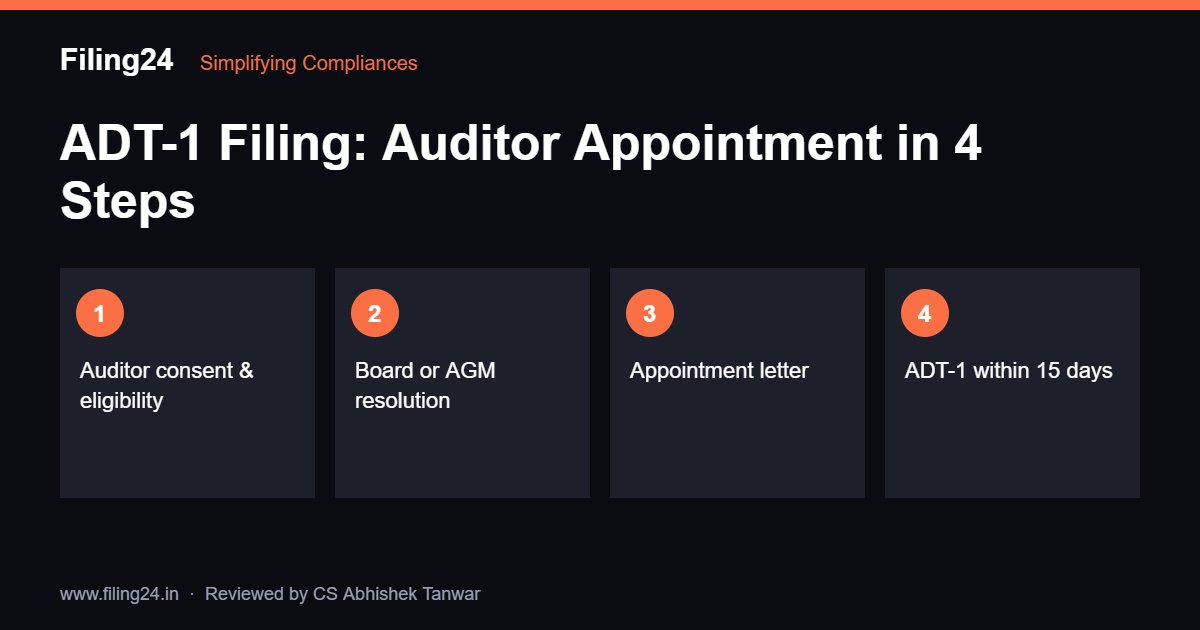
- Choose the auditor: a practising Chartered Accountant or CA firm that is eligible under Section 141.
- Get written consent and certificate: the auditor confirms consent and certifies that the appointment is within the limits and that they are not disqualified.
- Pass the resolution: a board resolution for the first auditor or a casual vacancy, or an ordinary resolution at the AGM for a five-year appointment.
- Issue the appointment letter: the company informs the auditor of the appointment and term.
- Prepare ADT-1: fill in auditor details (membership or firm registration number, PAN, address, email), term of appointment and meeting date.
- Sign and file: a director signs with DSC and the form is filed within 15 days of the meeting.
The whole ADT-1 filing takes less than a day when the documents are ready.
Who can and cannot be appointed as auditor
Eligible: an individual practising Chartered Accountant, or a CA firm or LLP where the majority of partners are practising CAs in India.
Not eligible (Section 141):
- An officer or employee of the company
- A partner or employee of an officer or employee of the company
- A person who, or whose relative or partner, holds securities above prescribed limits in the company
- A person indebted to the company above the prescribed limit
- A person with a business relationship with the company (other than ordinary course)
- A relative of a director or key managerial person
- A person who is already auditor of more than 20 companies
- A person convicted of fraud in the last ten years
The auditor’s eligibility certificate, attached in ADT-1 filing, confirms that none of these apply.
Auditor rotation rules
Most small private companies do not need to rotate auditors. Rotation under Section 139(2) applies to listed companies and certain unlisted public and private companies that cross specified thresholds of paid-up capital or borrowings. For such companies, an individual auditor can serve one term of five years and an audit firm two terms of five years, followed by a cooling-off period of five years. Our team checks whether rotation applies before your ADT-1 filing.
Auditor resignation and ADT-3
If an auditor resigns, a different form comes into play. The resigning auditor files Form ADT-3 with the ROC within 30 days of resignation, stating the reasons. The company must then fill the casual vacancy:
- The board appoints a new auditor within 30 days.
- Because the vacancy arose from resignation, the appointment must be approved by shareholders at a general meeting within three months.
- The new auditor holds office until the next AGM, and the company completes ADT-1 filing for the appointment.
Removing an auditor before the end of the term is a bigger step. It needs a special resolution and prior approval of the Central Government (Regional Director) through Form ADT-2. Our team can guide you if you are considering a change.
Common mistakes in ADT-1 filing
- Missing the 15-day window: the clock starts from the meeting date, not from the date the auditor signs consent.
- Wrong term: the five-year term must be stated correctly, from the conclusion of one AGM to the sixth AGM.
- Incorrect firm details: the firm registration number and PAN must match ICAI and income tax records.
- No consent attached: ADT-1 filing without the auditor’s consent and eligibility certificate can be marked defective.
- Confusing ADT-1 with AOC-4: both are filed after the AGM but serve different purposes. Plan them together.
Fees and timeline
| Item | Amount / time |
|---|---|
| Filing24 professional fee | ₹1,499 |
| Government fee | As per the MCA fee table, based on authorised capital |
| Additional fee for delay | Increases with the period of delay |
| Time to file | 24–48 hours after documents are received |
Want ADT-1 handled together with your annual filings? Our private limited company annual compliance plan includes ADT-1, AOC-4 and MGT-7. New companies can add it to our post-incorporation compliance service.
Documents needed for ADT-1 filing
- Certified copy of the board or shareholder resolution
- Written consent of the auditor
- Eligibility certificate from the auditor under Section 141
- Copy of the appointment letter issued to the auditor
- Auditor’s membership number or firm registration number, PAN, email and address
- DSC of a director
Details of the form are available on the official MCA portal.
How to choose the right auditor for your company
The auditor you appoint will review your books every year for at least five years, so it is worth choosing carefully. Look for:
- Relevant experience: a CA firm that audits companies of your size and industry, such as SaaS, manufacturing or trading.
- Timeliness: an auditor who can complete the audit by August, leaving time for the AGM and ROC filings.
- Technology: comfort with cloud accounting software and digital document sharing.
- Fair fees: a clear quote based on your transaction volume, without surprises.
- Independence: no family or business relationship with directors that could disqualify them.
If you do not have an auditor, Filing24 can introduce you to qualified independent CA firms. The auditor remains fully independent of our compliance team, as the law requires.
ADT-1 filing timeline in a typical year
For a company that holds its AGM on 25 September and appoints a new auditor for five years, the timeline looks like this:
- August: auditor consent and eligibility certificate received; board recommends the appointment in the AGM notice.
- 25 September: shareholders pass the ordinary resolution at the AGM.
- By 10 October: ADT-1 filing completed (within 15 days).
- By 25 October: AOC-4 filed (within 30 days of the AGM).
- By 24 November: MGT-7 or MGT-7A filed (within 60 days).
Planning these together avoids last-minute stress and late fees.
ADT-1 filing for companies that change auditors
Companies often change auditors when they grow, raise funding or want a firm with industry experience. Changing auditors at the end of a term is simple: shareholders appoint the new auditor at the AGM, and ADT-1 filing follows within 15 days. Changing mid-term is harder, because the existing auditor must either resign (and file ADT-3) or be removed with Central Government approval.
Before you switch, make sure the outgoing auditor has completed the current year’s audit or that the handover is planned, so your AOC-4 is not delayed. The incoming auditor will usually ask for the previous audited accounts, the trial balance and a no-objection communication from the outgoing auditor as per professional practice. Our team coordinates this handover so that the change does not disrupt your annual compliance.
Checklist for a smooth auditor change
- Confirm the term and notice requirements in the existing appointment
- Get the new auditor’s consent and eligibility certificate
- Include the appointment in the AGM notice with explanatory statement
- Pass the resolution and complete ADT-1 filing within 15 days
- Update the auditor’s details with your bank if required for loan covenants
Reviewed by CS Abhishek Tanwar, Filing24
Our guides are written and reviewed by the Filing24 compliance team and checked against the Companies Act, 2013, MCA notifications and official government portals. Last reviewed: 17 November 2026. Spotted something outdated? Message us on WhatsApp and we will correct it.
Appointing an auditor?
Send us the auditor’s consent and we will complete your ADT-1 filing within 24–48 hours.