

If you just started a company in India, someone has probably told you “startups don’t pay tax for 3 years.” That’s half true, and the half they leave out is the part that trips up most founders. The Startup Tax Exemption under Section 80-IAC is real, its generous, but it is not automatic — you have to apply for it separately, and most founders don’t.
I’ve been a practicing Chartered Accountant for over 10 years now, and I still see this mistake every single ITR season: a founder gets their DPIIT certificate, assumes the tax holiday kicked in on its own, and finds out only during assessment that they owe full tax. So let’s fix that confusion here, properly.
By mid-2026, India has crossed 2,07,000 DPIIT-recognised startups, but only around 3,700 of them actually hold the second certificate that unlocks the Startup Tax Exemption — that’s an uptake rate under 2%. This guide is written so you don’t end up in that unlucky 98%.
Table of Contents
- What is Startup Tax Exemption?
- Types of Tax Exemptions Available to Startups
- Eligibility Criteria for Section 80-IAC (2026)
- Documents Required
- How to Claim Startup Tax Exemption: Step-by-Step
- 80-IAC vs Concessional Tax Regime (115BAA) — Which is Better?
- Common Mistakes Founders Make
- Checklist Before You Apply
- FAQs (People Also Ask)
What is Startup Tax Exemption?
Startup Tax Exemption refer to the tax benefits given by the Indian government to DPIIT-recognised startups, the biggest one being a 100% deduction on business profit for any 3 consecutive years out of the first 10 years since incorporation, under Section 80-IAC of the Income Tax Act. It exist to help early-stage companies reinvest cash instead of paying it out as tax.
In simple word — instead of paying corporate tax at 25-30%, an eligible startup pays zero tax on profits for 3 chosen years. For a startup making ₹4-5 crore taxable profit, that is easily ₹1.2-1.5 crore saved in a single year.
Types of Tax Exemptions Available to Startups
There isn’t just one benefit. A DPIIT-recognised startup can access several exemptions, and understanding all of them together is what actually moves the needle.
| Exemption | Section | What it Covers |
|---|---|---|
| Income Tax Holiday | 80-IAC | 100% deduction on profits for 3 consecutive years (out of first 10) |
| Angel Tax Exemption | 56(2)(viib) | No tax on share premium received from investors above fair value |
| ESOP Tax Deferral | 192(1C) | Tax on ESOPs deferred to sale/exit instead of on exercise |
| Capital Gains Exemption | 54GB | Exemption on long-term capital gains reinvested in eligible startup shares |
| Carry Forward of Losses | 79 | Relaxed shareholding continuity rules for loss carry-forward |
Most CAs (including me) recommend treating these as a package — because DPIIT recognition is the master key that unlocks all five, not just the headline 80-IAC benefit.
Eligibility Criteria for Section 80-IAC (2026)
What is the eligibility for Startup Tax Exemption? A company or LLP must be DPIIT-recognised, incorporated within the notified window, working towards innovation or scalable business model, have annual turnover under ₹100 crore, and not formed by splitting up an existing business, to claim the 80-IAC exemption.
Here’s the fuller checklist:
- Entity must be a Private Limited Company or LLP (proprietorships and partnerships don’t qualify)
- Incorporated on or after the notified cut-off date, and within 10 years of incorporation
- Holds valid DPIIT recognition in every year the exemption is claimed
- Annual turnover has not exceeded ₹100 crore in any financial year since incorporation
- Working towards innovation, development, or improvement of products/services, or has a scalable business model with high employment or wealth creation potential
- Not formed by splitting up or reconstructing an already existing business
- Not formed by transfer of used machinery/plant beyond permitted limits
- Company must be on the old tax regime — you cannot claim 80-IAC if you’ve opted for the concessional rate under Section 115BAA
Meeting 5 out of 6 conditions gets you nothing — this is a complete-test benefit, not a partial one.
Documents Required
Keep these ready before you start the application — this alone saves most founders weeks of back-and-forth:
- Certificate of DPIIT recognition
- Certificate of Incorporation
- Memorandum of Association (MOA) and current shareholding pattern
- Board resolution authorising the application
- Income Tax Return acknowledgements for all years since incorporation
- Audited financial statements
- Write-up/pitch deck describing the innovation or scalable model
How to Claim Startup Tax Exemption: Step-by-Step
This is where most guides stop short — DPIIT recognition is step one, not the finish line.
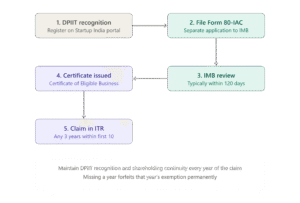
- Get DPIIT Recognition — Register on the Startup India portal and apply for recognition as a startup.
- Apply for 80-IAC Certification separately — File Form 80-IAC through the Startup India portal. This goes to the Inter-Ministerial Board (IMB), not DPIIT.
- IMB Review — The IMB evaluates innovation quality, scalability, and employment potential. As of 2026, reviews are typically completed within 120 days.
- Receive Certificate of Eligible Business — Only after IMB approval can you actually claim the deduction.
- Choose your 3-year window wisely — You don’t have to claim it in your first profitable year. Most CAs advise picking the 3 highest-profit years within the 10-year window to maximise absolute savings.
- Claim in ITR — Report the deduction while filing your Income Tax Return for the relevant assessment years, quoting the certificate.
- Stay compliant every year — Maintain DPIIT recognition and shareholding continuity (Section 79) throughout the claim period, or you risk losing the benefit for that year — permanently, with no carry forward.
80-IAC vs Concessional Tax Regime (115BAA) — Which is Better?
This is a genuine dilemma many founders face, and there’s no one-size-fits-all answer.
- 80-IAC gives 100% exemption for 3 years but only at the old, higher tax rate (25-30%) in other years
- 115BAA gives a flat 22% rate always, but you permanently give up 80-IAC once elected — it’s irrevocable
In my practice, fast-growing startups almost always come out ahead with 80-IAC, because 3 full years at zero tax on a higher profit base typically beats the flat 22% rate over the same period. But if your growth is slow and steady rather than a hockey-stick, run the actual numbers with your CA before electing either option — this decision can’t be reversed.
Common Mistakes Founders Make
- Assuming DPIIT recognition alone gives tax exemption (it doesn’t)
- Applying for 80-IAC without proper innovation documentation, leading to rejection
- Switching to Section 115BAA without realising it permanently blocks 80-IAC
- Missing the shareholding continuity condition under Section 79 mid-way through the claim period
- Not claiming in the most profitable years, losing out on maximum savings
Checklist Before You Apply
[✓ ] Entity is a Pvt Ltd or LLP, incorporated within the eligible window[✓] DPIIT recognition obtained and active[✓] Turnover under ₹100 crore in every year since incorporation[✓] On the old tax regime (haven’t opted for 115BAA)[✓] Innovation/scalability write-up prepared[✓] All ITR acknowledgements and audited financials ready[✓] Board resolution passed for the application[✓] Shareholding pattern documented and continuity maintainedFAQs (People Also Ask)
What is Startup Tax Exemption? It is a set of tax benefits, mainly under Section 80-IAC, that lets DPIIT-recognised Indian startups claim 100% deduction on business profit for 3 consecutive years within their first 10 years of incorporation.
Who is eligible for Startup Tax Exemption in 2026? A DPIIT-recognised Private Limited Company or LLP, incorporated within the notified window, with turnover under ₹100 crore, working on innovation or a scalable model, and on the old tax regime, is eligible.
Is DPIIT recognition enough to get the tax exemption? No. DPIIT recognition only makes you eligible to apply. You must separately file Form 80-IAC and get approval from the Inter-Ministerial Board to actually claim the exemption.
Can a proprietorship or partnership firm claim 80-IAC? No, only Private Limited Companies and LLPs are eligible for the Section 80-IAC startup tax exemption.
How long does IMB approval take? As of 2026, the Inter-Ministerial Board generally completes its review within around 120 days of a complete application.
Can I choose any 3 years for the exemption? Yes, you can choose any 3 consecutive years out of the first 10 years since incorporation — most advisors suggest picking your 3 highest-profit years.
What happens if I miss claiming the exemption in a particular year? The benefit for that year is lost permanently. It cannot be carried forward to a later year.
In Summary
The Startup Tax Exemption is one of the most valuable, and most underused, benefits available to Indian founders. The gap isn’t in the policy — it’s in awareness and paperwork. Get your DPIIT recognition, file Form 80-IAC properly with solid documentation, and time your 3-year claim around your highest-profit years. If in doubt, sit down with a practicing CA before you elect any tax regime — some of these choices can’t be undone.
Suggested External Links (DoFollow)
- Startup India official portal: https://www.startupindia.gov.in
- Income Tax Department e-filing portal: https://www.incometax.gov.in
Suggested Internal Links
- Link to your own articles on: “DPIIT Recognition Process”, “Startup Registration Checklist”, “Angel Tax Exemption Explained”